Wednesday, March 19, 2014

Linear Programming


Vertices:
 0,6
 0,0
 6,0

Constraints
Objective Function: 
x ≥ 0
y ≥ 0
x + y ≤ 6
 C=3x+4y
 C=24
 C=0
 C=18


Vertices:
 -5,4
 0,6
 0,4

Constraints
Objective Function: 
x ≤  5
y ≥ 4
-2x +5 y ≤ 30
 C=2x+5y
 C=30
 C=20
 C=10


Vertices:
 0,9.5
 0,2
 5,2

Constraints
Objective Function: 
x ≥ 1
y ≥ 2
6x + 4y ≤ 38
 C=7x+3y
 C=28.5
 C=6
 C=41


Vertices:
 0,8
 0,4
 6,8

Constraints
Objective Function: 
x ≥ 0
y ≤ 8
-2x + 3y ≤ 12
 C=4x+6y
 C=48
 C=24
 C=72


Vertices:
 0,5
 0,0
 2,3
 8,0
Constraints
Objective Function: 
x ≥ 0
y ≥ 0
4x + 4y ≤ 20
x + 2y ≤ 8
 C=8x+7y
 C=35
C= 0
 C=37
 C=64
=


Vertices:
0,4
 0,0
 4,3
 16,0
Constraints
Objective Function: 
x ≥ 0
2x + 3y ≥ 6
3x - y ≤ 9
x + 4y ≤ 16
 C=3x+5y
C= 20
 C=0
 C=27
C= 48

Tuesday, March 4, 2014

Arithmetic and Geometric

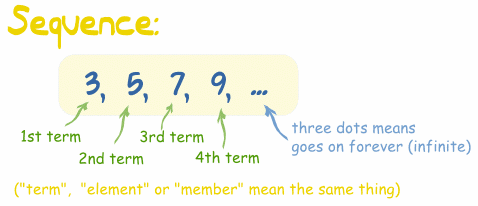
Sequence- Is an ordered list of terms or elements.
 
Arithmetic sequence formula- In an Arithmetic Sequence the difference between one term and the next is a constant. Also called the Common Difference.
 

Geometric sequence formula- In a Geometric Sequence each term is found by multiplying the previous term by a constant. Also called the Common Ratio.
Example:
2, 4, 8, 16, 32, 64, 128, 256, ...
This sequence has a factor of 2 between each number. Each term (except the first term) is found by multiplying the previous term by 2.
Finite sequence- Is a function with domain 1,2,3.

Infinite sequence- Is a function with domain 1,2,3,4.... etc.

Series- Is the sum of a sequence.

Explicit formula- Each domain is an answer not based on any values.

Recursive Formula- Each domain is a answer based on a previous answer.

Graphing Exponential Equations

Graphing Exponential Equations

  • Graphing Exponential Growth/Decay

  • 1. Create the Parent Graph.
    2. Identify A,H,K.
    3. Create your new T-Chart.

    • Domain: All real #'s.
    • Range: y>k; when a is positive. y<k; when a is negative.
    • Asymptote: y=k.
    4. Draw Asymptote.
    5. Graph new points.

    • Exponential Formula: y=a×bx-h+k
    • a = multiplier.
    a>1 = stretch
    0<a<1 = compression
    a< 0(negative) = flipped over x-axis.

    • b = base
    b>1 = whole #, growth, always increasing.
    0<b<1 = fraction; decay, always decreasing.
    B is never negative only the multiplier is.

    • h = lf/rt; opposite
    • k = up/dn

    Monday, March 3, 2014

    Compound Interest

    Compound Interest

    Interest calculated on the initial principal and also on the accumulated interest of previous periods of a deposit or loan. Compound interest can be thought of as “interest on interest,” and will make a deposit or loan grow at a faster rate than simple interest, which is interest calculated only on the principal amount.


     = [P (1 + i)n] – P

    = P [(1 + i)n – 1]


    Compound Interest = Total amount of Principal and Interest in future (or Future Value) less Principal amount at present (or Present Value)