Section 1
CC Alg I - Jon'Nea Lambert
Friday, April 18, 2014
Wednesday, March 19, 2014
Linear Programming
Vertices:
|
||||||||
Constraints
|
Objective Function:
|
|||||||
x ≥
0
y ≥
0
x + y ≤ 6
|
||||||||
|
|
||||||||
Vertices:
|
||||||||
Constraints
|
Objective Function:
|
|||||||
x ≤ 5
y ≥ 4
-2x +5 y ≤ 30
|
||||||||
|
|
||||||||
Vertices:
|
||||||||
Constraints
|
Objective Function:
|
|||||||
x ≥ 1
y ≥ 2
6x + 4y ≤ 38
|
||||||||
|
|
||||||||
Vertices:
|
||||||||
Constraints
|
Objective Function:
|
|||||||
x ≥
0
y ≤ 8
-2x + 3y ≤ 12
|
||||||||
|
|
||||||||
|
Vertices:
|
|
|
|
|
||||
|
Constraints
|
Objective Function:
|
|||||||
|
x ≥
0
y ≥
0
4x + 4y ≤ 20
x + 2y ≤ 8
|
|
|
|
|
=
| |||
Tuesday, March 4, 2014
Arithmetic and Geometric
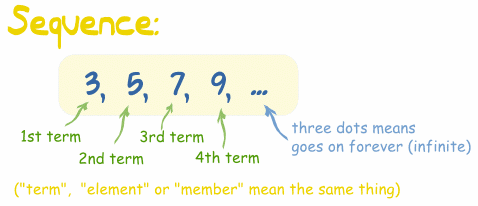
Sequence- Is an ordered list of terms or elements.
Arithmetic sequence formula- In an Arithmetic Sequence the difference between one term and the next is a constant. Also called the Common Difference.
Geometric sequence formula- In a Geometric Sequence each term is found by multiplying the previous term by a constant. Also called the Common Ratio.
Infinite sequence- Is a function with domain 1,2,3,4.... etc.
Series- Is the sum of a sequence.
Explicit formula- Each domain is an answer not based on any values.
Recursive Formula- Each domain is a answer based on a previous answer.
Arithmetic sequence formula- In an Arithmetic Sequence the difference between one term and the next is a constant. Also called the Common Difference.
Geometric sequence formula- In a Geometric Sequence each term is found by multiplying the previous term by a constant. Also called the Common Ratio.
Example:
| 2, 4, 8, 16, 32, 64, 128, 256, ... |
This sequence has a factor of 2 between each number. Each term (except the first term) is found by multiplying the previous term by 2.
Finite sequence- Is a function with domain 1,2,3.Infinite sequence- Is a function with domain 1,2,3,4.... etc.
Series- Is the sum of a sequence.
Explicit formula- Each domain is an answer not based on any values.
Recursive Formula- Each domain is a answer based on a previous answer.
Graphing Exponential Equations
Graphing Exponential Growth/Decay
0<a<1 = compression
a< 0(negative) = flipped over x-axis.
1. Create the Parent Graph.
2. Identify A,H,K.
3. Create your new T-Chart.
- Domain: All real #'s.
- Range: y>k; when a is positive. y<k; when a is negative.
- Asymptote: y=k.
4. Draw Asymptote.
5. Graph new points.
- Exponential Formula: y=a×bx-h+k
- a = multiplier.
0<a<1 = compression
a< 0(negative) = flipped over x-axis.
- b = base
0<b<1 = fraction; decay, always decreasing.
B is never negative only the multiplier is.
- h = lf/rt; opposite
- k = up/dn
Monday, March 3, 2014
Compound Interest
Compound Interest
Interest calculated on the initial principal and also on the accumulated interest of previous periods of a deposit or loan. Compound interest can be thought of as “interest on interest,” and will make a deposit or loan grow at a faster rate than simple interest, which is interest calculated only on the principal amount.
= [P (1 + i)n] – P
= P [(1 + i)n – 1]
Compound Interest = Total amount of Principal and Interest in future (or Future Value) less Principal amount at present (or Present Value)
Interest calculated on the initial principal and also on the accumulated interest of previous periods of a deposit or loan. Compound interest can be thought of as “interest on interest,” and will make a deposit or loan grow at a faster rate than simple interest, which is interest calculated only on the principal amount.
= [P (1 + i)n] – P
= P [(1 + i)n – 1]
Compound Interest = Total amount of Principal and Interest in future (or Future Value) less Principal amount at present (or Present Value)
Tuesday, February 25, 2014
Tuesday, January 21, 2014
Domain- x values
Range- y values
End Behavior- How you describe both ends of x and y
Absolute Max/Min- 1 point that is the highest/lowest on a graph
Local Max/Min- more then one point that is the highest/lowest in a graph
Interval of Increase- section of a graph where y values are increasing described in terms of x
Interval of Decrease- section on a graph where the x values decrease
X intercept- point that crosses the x axis
Y intercept- point that crosses the y axis
Symmetry- based on even or odd, even symmetric of y axis odd is symmetric about the origin
Even/Odd/Neiher-
Asymptotes- imaginary line that get closer to the axis but never touches

Function- passes the vertical line test
One to One- passes vertical and horizontal line test
Range- y values
End Behavior- How you describe both ends of x and y
Absolute Max/Min- 1 point that is the highest/lowest on a graph
Local Max/Min- more then one point that is the highest/lowest in a graph
Interval of Increase- section of a graph where y values are increasing described in terms of x
Interval of Decrease- section on a graph where the x values decrease
X intercept- point that crosses the x axis
Y intercept- point that crosses the y axis
Symmetry- based on even or odd, even symmetric of y axis odd is symmetric about the origin
Even/Odd/Neiher-
Asymptotes- imaginary line that get closer to the axis but never touches
Function- passes the vertical line test
One to One- passes vertical and horizontal line test
Subscribe to:
Comments (Atom)